


Mortgage lending in Togo: how to finance the purchase of an existing property?
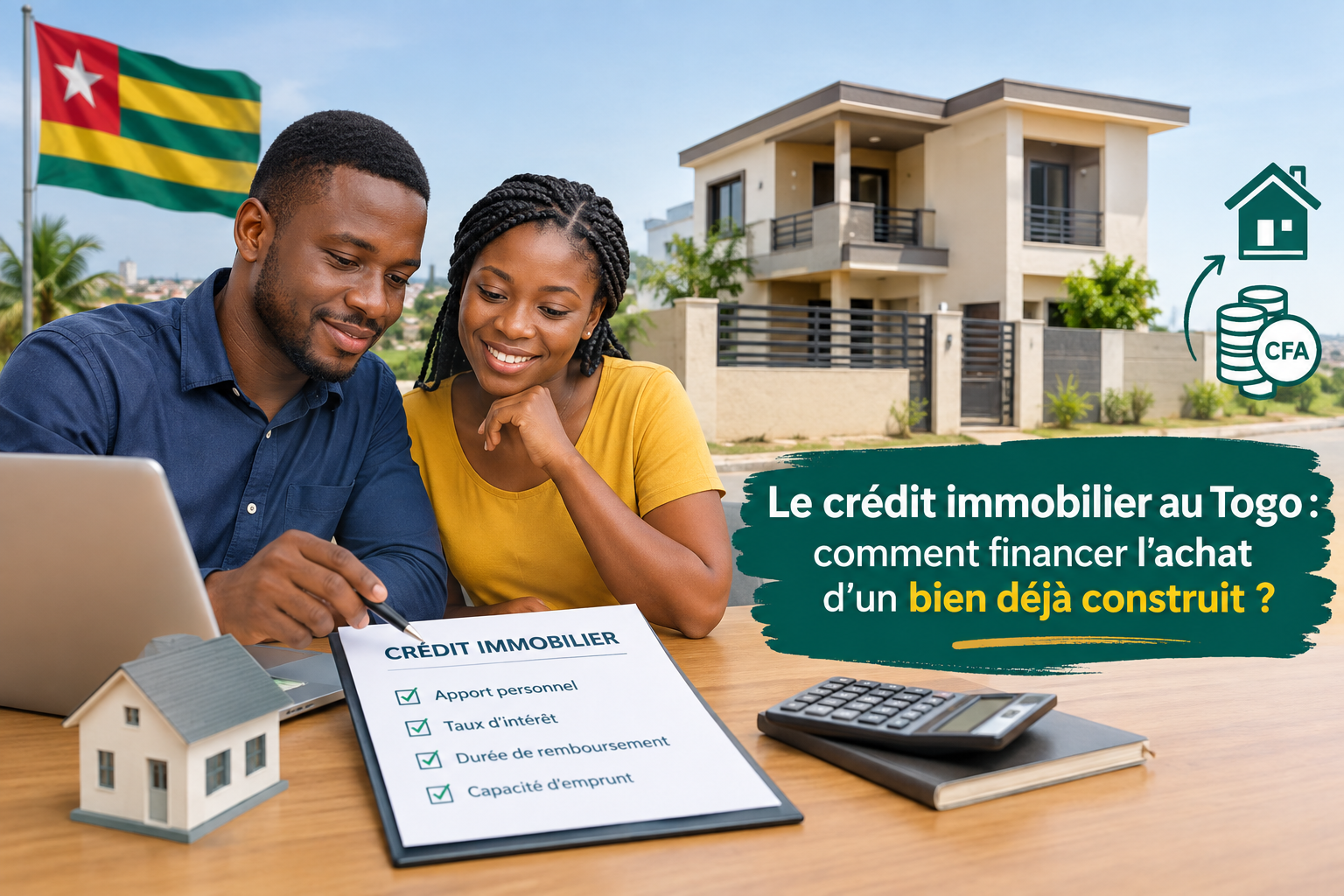
Mortgage credit in Togo: how to finance the purchase of an already built property
Acquiring an already built house or building is, for many Togolese households, a major step in building wealth — often faster and less risky than building « from scratch ». But between the sales promise, title verification, and loan disbursement, the process remains poorly understood. This article provides an overview of the mechanisms, the players, and above all the documents to gather to secure real estate financing in Togo — before broadening the perspective to short- and long-term construction financing alternatives.
1. Why buying an already built property is attracting more and more buyers
Unlike a construction loan, which finances an uncertain operation (site delays, budget overruns, defects), buying a finished property has a central advantage for lenders: the property exists, it can be visited, measured, and assessed immediately. This reduces credit risk and, in theory, facilitates the granting of financing — provided that the legal and technical file is complete.
2. The legal framework: the Togolese Land and Property Code
Togo has adopted a new Land and Property Code through Law No. 2018-005 of June 14, 2018, which replaces the old 1974 ordinance and thoroughly modernizes the country's land management, with 736 articles covering in particular the securing of transactions, the fight against land speculation, and double registration. Within this framework, the title deed can take several forms depending on the history of the plot:
- The land title: an official document issued by the Land Registry, which definitively and incontestably establishes the right of ownership over a property. Without it, land cannot be legally sold or used as bank collateral;
- Registration, in principle optional, but which becomes mandatory in certain cases, particularly for a subdivision carried out on unregistered land;
- Documents prior to registration (certificates, customary sales deeds) which must be regularized before any large-scale bank transaction, the legal security of the property ultimately resting on the land title.
The procedure for obtaining a land title has been simplified and takes place in three main stages: a simple plan of the land, drawn up by a surveyor, is submitted to the one-stop land desk, now attached to the Togolese Revenue Office (OTR); if the land is deemed free of any dispute, the file is transmitted to a notary for the establishment of a notarized deed; this deed is then submitted to the OTR, which calculates the fees to be paid, before the definitive establishment of the title. The minimum time is about 3 months, due to the publication period in the Official Journal, but in practice it takes between 3 and 6 months depending on the complexity of the file, for a starting cost of around 86,000 CFA francs.
3. The players financing real estate purchases in Togo
- Commercial banks offer classic mortgage loans, backed by a first-rank mortgage on the land title of the acquired property, with terms of up to 20-25 years for formal-sector employees;
- Decentralized financial systems (SFDs), particularly developed in Togo — the country has the best financial inclusion rate in the WAEMU area, around 90 % according to the most recent data — cater more to self-employed individuals and entrepreneurs in the informal economy;
- The National Inclusive Finance Fund (FNFI), supported by the « Ministry of Financial Inclusion and Organization of the Informal Sector » — an institutional architecture specific to Togo, which has granted several hundred thousand credits since 2014, plays a buffer role for profiles excluded from classic bank credit.
4. The typical process for a mortgage application
Step 1 — Verification of the land title
Before any financial commitment, the buyer (or the bank) must verify, with the Land Registry, that the property has a regular land title, free of double registration or dispute. This is a central point of vigilance in Togo, the new Land Code having been specifically designed to put an end to the phenomena of double sales of the same plot.
Step 2 — Property appraisal
A real estate expert is mandated to assess the market value of the property, according to a standard methodology: assessment of the bare land per m² according to prices in the area, assessment of the buildings by their new replacement cost, less depreciation linked to age and maintenance. This report serves as the basis for the bank to calibrate the loan amount — financing rarely exceeds 70 to 80 % of the value of an already developed property, knowing that some institutions can finance up to 80 to 100 % of the value depending on the client's personal contribution.
Step 3 — Notarized sales promise
Before the final deed of sale, the parties generally sign a sales promise before a notary, which precisely identifies the property, sets the price and payment schedule, and sets out the suspensive conditions (tax clearance, utility waivers, vacating of premises). It is often on this basis that the bank processes the application, before releasing the funds at the signing of the authentic deed.
Step 4 — Bank processing and loan disbursement
Once the file is complete, the bank proceeds with the analysis of repayment capacity, the establishment of the mortgage on the land title, and then the disbursement of funds. The total time depends mainly on the speed of gathering the land documents rather than on the bank processing itself.
5. Documents to gather: the practical checklist
| Document | Role in the file |
|---|---|
| Land title (or registration file in progress) | Proof of ownership rights over the plot |
| Plan drawn up by an approved surveyor | Technical basis for registration and appraisal |
| Notarized deed | Legal formalization of the property transfer |
| Certificate of situation issued by the OTR / Land Registry | Confirmation of the absence of dispute or double registration |
| Real estate appraisal report | Valuation basis for the loan |
| Notarized sales promise | Contractual commitment between parties |
6. Financing alternatives: buying outright with a long-term loan, or building gradually with short-term credit
Beyond buying an already built property, many Togolese households combine — or choose between — two very different financing logics.
6.1. Classic mortgage loan: long-term, lighter monthly payments
- Duration: most often 10 to 20 years, with some offers extending to 20-25 years depending on the profile and institution;
- Interest rate: generally between 7 % and 12 % per year;
- Legal ceiling (usury rate): 14 % per year for banks, 24 % for microfinance institutions, ceilings common to the entire WAEMU zone since their revision in 2026;
- Personal contribution generally required: 10 to 20 % of the project cost, with the loan amount potentially reaching 80 % to 100 % of the property value depending on this contribution;
- Usual guarantee: first-rank mortgage registered on the land title.
6.2. Short-term financing: consumer credit for gradual construction
As elsewhere in the WAEMU zone, classic mortgage credit remains in the minority compared to the construction needs of Togolese households. A significant share of construction projects is financed by successive consumer loans — foundations, then walls, then roofing, then finishing — each phase repaid before starting the next, with durations of 12 to 60 (or even up to 83) months and lighter guarantees than a mortgage (salary domiciliation, guarantee).
6.3. Why gradual construction can be cheaper overall
The total cost of a loan depends on the rate and the duration during which this rate applies to an outstanding capital. A sequence of short loans, each repaid before the next starts, exposes the borrower to interest over a cumulative period often much shorter than a single mortgage loan over 15 to 20 years bearing on the entire capital from day one. It is this mechanism that explains why households disciplined in their repayment can ultimately pay less in cumulative interest by building « in stages » — at the price of a site spread over several years and progressive occupation discomfort.
6.4. Other levers specific to the Togolese context
- The National Inclusive Finance Fund (FNFI): this Togolese public scheme, dedicated to financial inclusion and the informal sector, offers adapted financing products (including products for agriculture and youth) that can indirectly support the savings and self-build capacity of non-salaried households;
- Decentralized financial systems (SFDs), particularly large cooperative structures, well established in Togo, whose assets relative to GDP are the highest in the WAEMU zone — a sign of their central role in local financing, including for housing;
- The Housing Loan Guarantee (GPL), carried at the regional level, which aims to secure banks that agree to finance properties whose land title is still being regularized.
7. Points of vigilance for the buyer
- Always verify the existence and regularity of the land title before any significant payment, the new Land Code having been specifically designed to put an end to double sales that long weakened the Togolese market;
- Compare the appraisal value with local market prices, which evolve quickly in expanding urban areas (Greater Lomé in particular);
- Check the suspensive conditions of the sales promise: tax clearance, utility waivers, effective vacating of premises;
- Anticipate ancillary costs: notary fees, registration fees, transfer fees, costs related to the OTR and the Land Registry;
- Compare APRs, not just the advertised nominal rates, to know the real cost of credit.
Conclusion
Financing a real estate project in Togo — buying an already built property or gradual construction — relies on a balance between the solidity of the land title, the rigor of the technical appraisal, and an informed choice between two credit logics with opposite mechanics. Driven by one of the highest financial inclusion rates in the WAEMU zone and by an institutional architecture dedicated to the inclusion of the informal sector, Togo has a favorable environment for this choice to continue balancing out, without ever exempting the buyer from the documentary vigilance that protects their investment.


comment
No comments
Leave a comment