


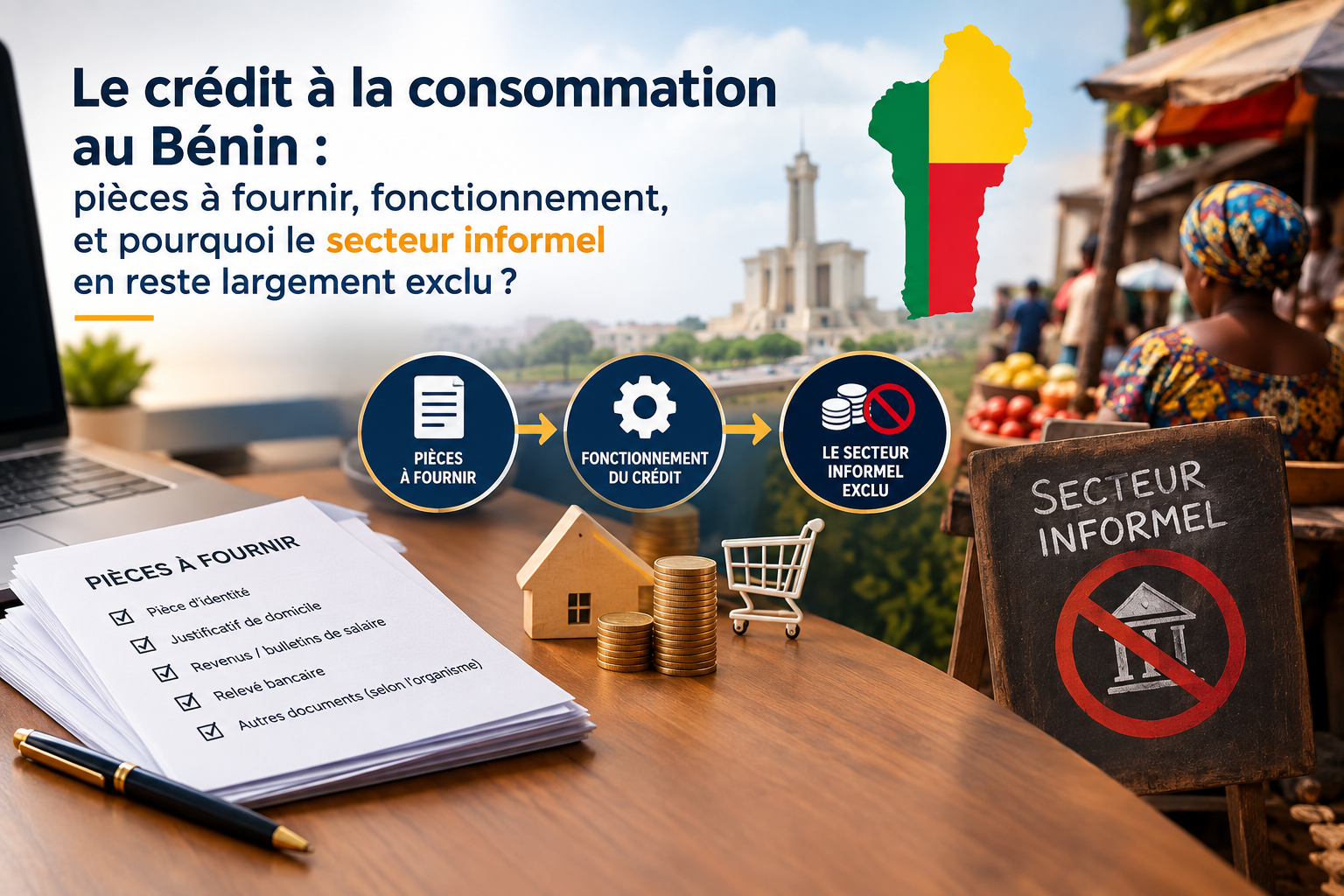
Consumer credit in Togo: required documents, how it works, and why the informal sector remains largely excluded?

Consumer credit in Togo: documents required, how it works, and why the informal sector remains largely excluded ?
Consumer credit, along with mortgage credit, is one of the most sought-after products in Togolese banks: it finances the purchase of equipment, a family event, school fees, or a temporary cash need. Unlike mortgage credit, it requires neither a mortgage nor a land title, which in theory makes it more accessible. But it remains built around a specific profile: the formal-sector employee, under contract, whose income is verifiable and can be domiciled. This article details the typical process of a consumer credit application, then analyzes why this same process remains difficult to access for informal economy profiles, who are largely in the majority in Togolese economic activity.
1. What is consumer credit?
Consumer credit is a medium-term loan, either unallocated or allocated to a specific use (purchase of equipment, financing a family event), which differs from mortgage credit by the absence of a mortgage guarantee and by much shorter terms. It relies above all on the borrower's regular repayment capacity, generally demonstrated by a domiciled salary.
2. The standard application: documents required for a formal-sector employee
A consumer credit application for an employee on a permanent contract typically includes the following categories of documents, a practice largely shared with other countries in the WAEMU zone:
2.1. Identity and civil status
- Valid identity document: Togolese national identity card or CEDEAO biometric identity card;
- Client confidential information form: internal form recording civil status, family situation, full address, as well as a declaration of assets and existing financial charges.
2.2. Employment and income proof
- Employment contract (ideally permanent);
- Certificate of employment issued by the employer;
- Recent pay slips (generally the last three months).
2.3. Irrevocable salary domiciliation
This is the central piece of the arrangement: an irrevocable domiciliation letter, sent by the employer to the employee's bank, committing to pay all remuneration into the account opened with that bank. This domiciliation constitutes, in fact, the main guarantee of consumer credit, giving the bank direct visibility over the borrower's income.
2.4. Summary of documents usually required
| Category | Documents |
|---|---|
| Identity | Valid Togolese national identity card or CEDEAO card |
| Personal situation | Confidential information form (civil status, charges, assets) |
| Employment | Employment contract, certificate of employment from employer |
| Income | Last 3 pay slips |
| Guarantee | Irrevocable salary domiciliation (employer letter + employee letter + RIB) |
| Bank account | Bank account details (RIB) |
3. Approval conditions: what weighs in the decision
- The assignable portion: the monthly payment, added to existing loans, generally cannot exceed 33 to 40 % of net salary;
- Contractual status: a permanent contract is often required, as well as a maximum age at loan maturity;
- Duration: most often 12 to 60 months, with some offers reaching up to 80-83 months;
- Loan-related insurance, compulsory in almost all offers;
- The effective annual rate (APR), the only indicator reflecting the true cost of credit.
4. Specific complications for informal sector profiles
The services sector alone represents nearly half of Togo's GDP and employs about half of the active population, a significant part of this activity being informal — retail trade, crafts, small services. Yet the very structure of the consumer credit described above relies on elements that this public cannot, by definition, produce.
4.1. No employment contract or pay slip
Without a formal employer, there is no employment contract, no certificate of employment, and no regular monthly pay slip — the very foundation on which a bank assesses income stability.
4.2. The impossibility of domiciling a salary that does not exist
The central guarantee of classic consumer credit has no direct equivalent for self-employed income, which is irregular and spread across multiple channels (cash, mobile money).
4.3. A quantified reality: the weight of self-financing
In Togo, about 73 % of entrepreneurs start their business with their own funds, compared to barely 1 % who use informal financing sources and a still marginal share using bank credit or public programs — a pattern comparable to that observed in several neighboring countries in the zone. This figure concretely reflects the scale of the gap between the financing needs of self-employed individuals and the formal credit available for this profile.
4.4. No credit history and no real guarantees
An informal profile has, most of the time, never borrowed from a bank, and generally cannot offer the alternative guarantees (mortgage, joint guarantee from a salaried third party) that institutions require to compensate for the absence of domiciliation.
5. Alternatives being developed for this audience
- The National Inclusive Finance Fund (FNFI): a Togolese public scheme that has granted more than 105 billion CFA francs in credits to more than 1.8 million beneficiaries since 2014 — a volume that reflects the scale of demand not covered by classic bank credit, with targeted products such as access for farmers or young people to financial services;
- Decentralized financial systems (SFDs), particularly dense in Togo — 74 institutions identified, with a weight in GDP among the highest in the WAEMU zone — which remain the main point of contact between informal profiles and formal credit, through group solidarity guarantee mechanisms;
- Mobile money and nano-credit: Togo benefits from an expanding mobile payment ecosystem, which is beginning to serve as a data foundation for rapid financing products adapted to the occasional cash needs of traders;
- Alternative credit scoring: several technological solutions deployed in the sub-region now allow lenders to use non-traditional data (mobile money history, recharge behavior, cooperative activity) to build a credit score where no pay slip exists.
6. Points of vigilance, regardless of profile
- Compare the APR rather than just the advertised nominal rate;
- Check the assignable portion actually available before accumulating several loans;
- Carefully read the irrevocability clauses of the domiciliation;
- For an informal profile applying to an SFD, check the effective rate actually charged: the legal ceiling applicable to microfinance institutions (24 %) is higher than that of banks (14 %).
Conclusion
Consumer credit in Togo remains, in its classic banking architecture, tailored to the formal employee on a permanent contract. But the country stands out for an institutional architecture specifically dedicated to the inclusion of the informal sector — a full ministry, a National Inclusive Finance Fund with substantial volumes, and the highest financial inclusion rate in the WAEMU zone. This combination does not remove the structural obstacles described above, but it makes it a particularly active ground for testing tomorrow's responses: microfinance, mobile nano-credit, and alternative scoring based on non-traditional data.


comment
No comments
Leave a comment