


Consumer credit in Senegal: documents required, how it works, and why the informal sector remains largely excluded
Consumer credit in Senegal: documents required, how it works, and why the informal sector remains largely excluded
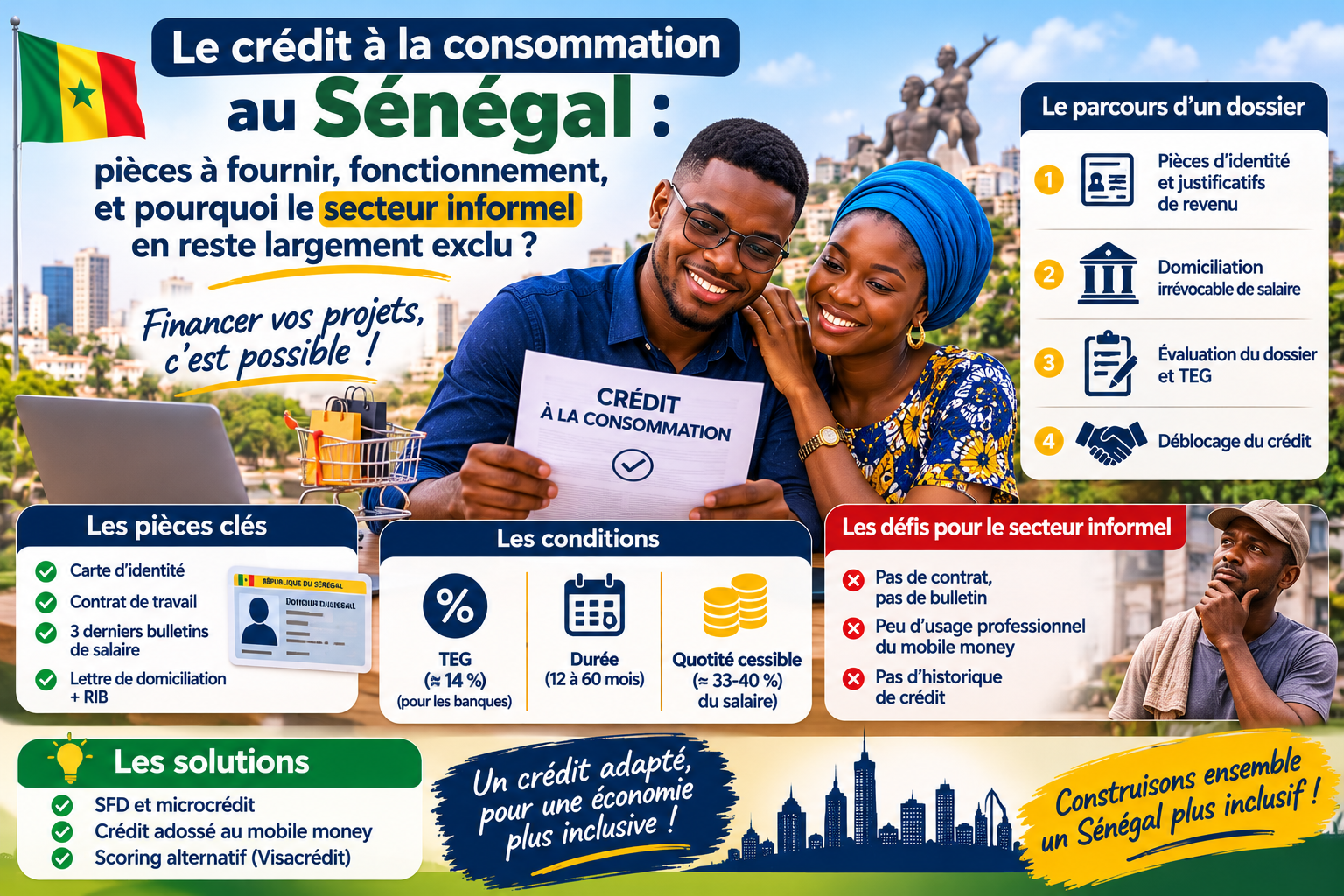
Consumer credit is one of the most sought-after products in Senegalese banks: it finances the purchase of equipment, a family event, or a temporary cash need. Unlike real estate credit, it requires neither a mortgage nor a land title, which in theory makes it more accessible. But it remains built around a specific profile: the formal-sector employee, under contract, whose income is verifiable and can be domiciled. This article details the standard process of a consumer credit application, then analyzes why this same process remains difficult to access for informal economy profiles, which are very present in Senegal's economic fabric, particularly in Dakar.
1. What is consumer credit?
Consumer credit is a medium-term loan, either unallocated or allocated to a specific use, which differs from real estate credit by the absence of a mortgage guarantee and by much shorter terms. It relies above all on the borrower's regular repayment capacity, generally demonstrated by a domicilable salary.
2. The standard application: documents required from a formal-sector employee
2.1. Identity and civil status
- Valid identity document: Senegalese national identity card or CEDEAO card;
- Client confidential information form: civil status, family situation, address, assets and existing financial charges.
2.2. Employment and income proof
- Employment contract (ideally permanent);
- Certificate of employment issued by the employer;
- Recent pay slips (generally the last three months).
2.3. Irrevocable salary domiciliation
This is the central piece of the arrangement: an irrevocable domiciliation letter, sent by the employer to the employee's bank, committing to pay all remuneration into the account opened with that bank, which constitutes the main guarantee of consumer credit.
2.4. Summary of documents usually requested
| Category | Documents |
|---|---|
| Identity | Valid Senegalese national identity card or CEDEAO card |
| Personal situation | Confidential information form (civil status, charges, assets) |
| Employment | Employment contract, certificate of employment from employer |
| Income | Last 3 pay slips |
| Guarantee | Irrevocable salary domiciliation (employer letter + employee letter + RIB) |
| Bank account | Bank account details (RIB) |
3. Approval conditions: what weighs in the decision
- The assignable portion: capped, in practice, at around 33-40 % of net salary depending on the institution (indicative order of magnitude), all loans combined;
- Contractual status: a permanent contract is often required;
- Duration: most often 12 to 60 months;
- The effective annual rate (APR), an indicator that includes interest and fees and reflects the real cost of credit.
4. Specific complications for informal-sector profiles
4.1. No employment contract or pay slip
Without a formal employer, there is no employment contract, no certificate of employment, and no regular monthly pay slip — the very foundation on which a bank assesses income stability.
4.2. The mobile money paradox: widely used, but little exploited for credit
According to the same survey, mobile money was adopted by almost all informal entrepreneurs in Dakar, primarily for personal use. Its professional use was much less widespread: about six out of ten entrepreneurs used it for professional purposes, and only about four out of ten used it several times a week. This paradox is central to understanding the exclusion from classic consumer credit: the transaction history that could, elsewhere, serve as a substitute for a pay slip is, to our knowledge, not yet fully valued by formal lenders, which opens room for development for credit services backed by mobile money.
4.3. A quantified reality: the weight of self-financing
In Senegal, about 74 % of entrepreneurs start and finance their activity with their own funds rather than with a bank loan or a public program, a pattern comparable to that observed in several neighboring countries (79 % in Benin, 81 % in Côte d'Ivoire, 85 % in Mali, according to the World Bank, Africa Economic Update 2026), and which suggests a gap between the financing needs of self-employed workers and the formal credit supply available.
4.4. No credit history and no real guarantees
An informal profile has, most of the time, never borrowed from a bank, and generally cannot offer the alternative guarantees that institutions require to compensate for the absence of salary domiciliation.
5. Alternatives being developed for this audience
- Decentralized financial systems (SFDs), with the UCCMS (Union of Credit Mutuel Senegal Funds, commonly referred to as "CMS") among the very leading microfinance networks in the WAEMU zone — a structuring actor for local financing of self-employed workers;
- Senegal (26.5 %) and Côte d'Ivoire (26.3 %) together concentrate 52.8 % of WAEMU microfinance assets at the end of 2025, making it a particularly developed market for financing self-employed workers, with in particular group solidarity guarantee mechanisms that replace the classic salary guarantee — even if portfolio quality remains a point of vigilance (non-performing loans of 6 % to 7.7 % of outstanding amounts according to figures communicated in October 2026, against a standard of 3 %);
- Mobile money-backed nano-credit: a natural relay given the adoption of mobile money by almost all informal entrepreneurs, with significant room for progress on the professional use of this transaction history;
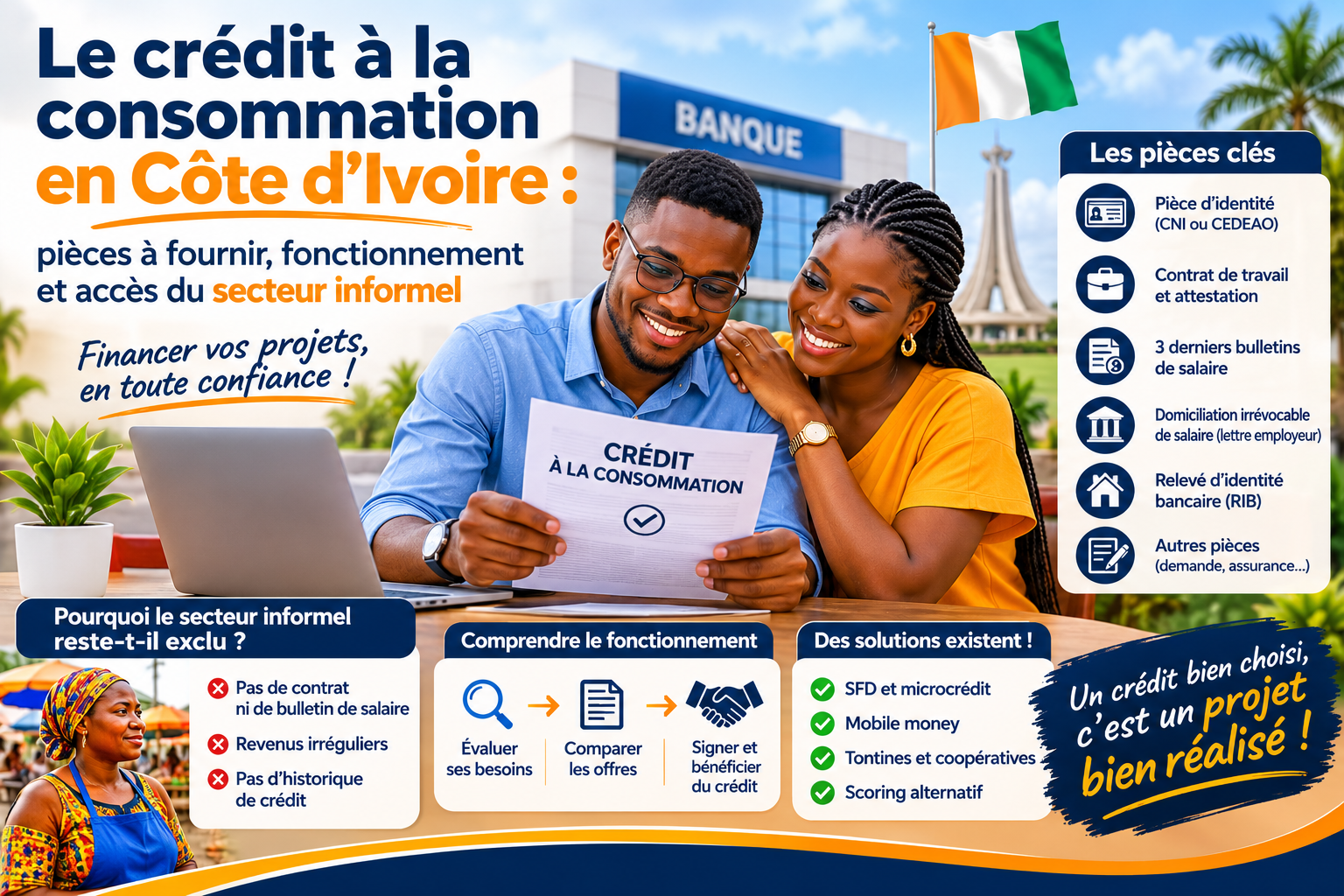
- Visacrédit's alternative credit scoring: technological solutions now make it possible to exploit non-traditional data (mobile money transactions, participation in tontines, cooperative activity) to build a credit score where no pay slip exists — a response directly calibrated to the Dakar paradox described above.
6. Points of vigilance, regardless of profile
- Compare the APR rather than just the advertised nominal rate;
- Check the assignable portion actually available before accumulating several loans;
- Carefully read the irrevocability clauses of the domiciliation;
- For an informal profile applying to an SFD, check the effective rate actually charged: the legal ceiling applicable to microfinance institutions (24 %) is significantly higher than that of banks (14 % since June 1, 2026, against 15 % previously).
Conclusion
Consumer credit in Senegal remains, in its classic banking architecture, tailored to the formal employee on a permanent contract — while the informal economy, with, in Dakar, fewer than one entrepreneur in two holding a formal account and a still-incomplete professional use of mobile money, remains largely excluded. Yet the potential is there: almost universal adoption of mobile money among informal entrepreneurs in Dakar and one of the most developed microfinance sectors in the WAEMU zone offer a solid base to build, in time, credit products truly adapted to this majority audience.
This article is provided for information purposes and does not constitute financial advice or a credit offer. Approval conditions vary by institution, and rates and rules evolve: verify them with your bank or microfinance institution before any commitment.
Sources and references
- Survey on the practices of Dakar's informal sector entrepreneurs and mobile money, Orange Hello Future.
- World Bank, Africa Economic Update 2026: share of entrepreneurs financed from own funds.
- Decision No. 19 of 29/12/2025/CM/WAEMU setting the usury rate (BCEAO), in force since June 1, 2026.
- WAEMU Banking Commission, 2025 annual report: microfinance assets (Senegal 26.5 %, Côte d'Ivoire 26.3 %).
- National coordination committee for microfinance activities in Senegal, 30th session (APS, October 2026): non-performing loans.

comment
No comments
Leave a comment